
- Details
- Written by: Ken Furtado
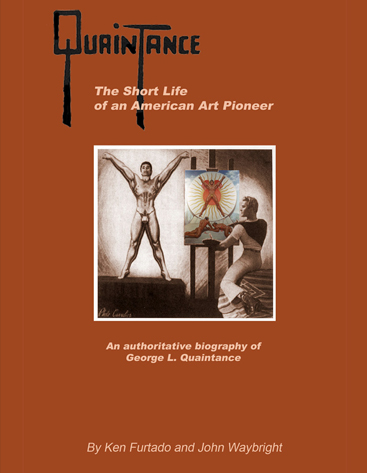
Of the 56 canvases that represent George Quaintance's "male physique" period, the whereabouts of 20 remains unknown. For nine of those, I have anecdotal information; for the remaining 11 I have no information whatsoever. Readers of this blog who may have information about any of these works are encouraged to post a comment or reply privately via email. (Note: Images are not shown in their true aspect ratios.)
It is also known that Quaintance painted at least six different studies of a handsome blond named Stephen Barclay, of which at least two were nudes. This was prior to the "Male Physique" paintings. Only two of the Barclay paintings are known today, neither of which is a nude.
- Details
- Written by: Ken Furtado
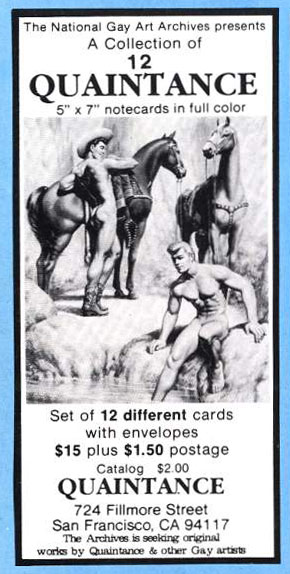 In 1982, a company calling itself Fun House produced a set of color notecards featuring 12 Quaintance paintings. The cards themselves measured 5x7 inches, were blank on the inside, and came with ivory-colored envelopes. The source of the original images is a mystery, but it surely was not the original paintings because the color reproduction on some of the cards is garish and inaccurate.
An article by Ted Smith, "The Art of George Quaintance," that appeared in issue #76 (February 1983) of In Touch for Men, announced the formation of an organization called the National Gay Art Archives (NGAA). It was described as "a non-profit organization dedicated to preserving this important part of our cultural heritage." The article contains reproductions of most of the notecards, a San Francisco address from which the cards might be ordered, a lot of factually incorrect information about Quaintance and his art studio and a plea for donations of money or art. Elsewhere in the issue is an illustrated advertisement for the cards.
- Details
- Written by: Ken Furtado
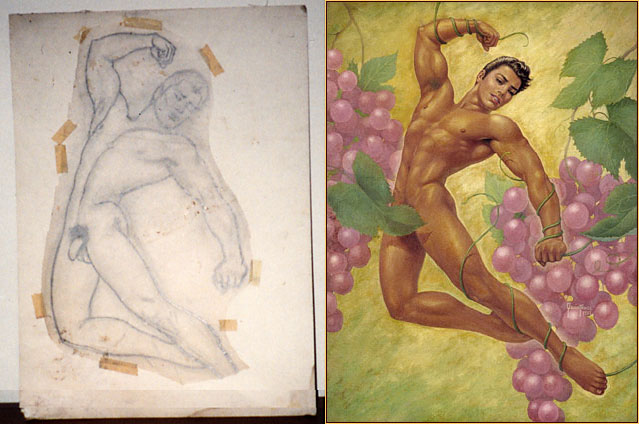 Though their subject matter may have been worlds apart, two techniques of Normal Rockwell and George Quaintance invite comparison. Both attended the illustrious Art Students League of New York, an establishment that has been around since 1875. Rockwell's attendance there preceded Quaintance's by nine years — 1910 versus 1919 — but they appear to have "taken home" some of the same learning.
The first technique was the execution of a detailed, full-sized sketch in charcoal on onionskin or tracing paper that would then be transferred to canvas. The artist would pin or tape the sketch to the canvas, then place transfer paper (similar to the carbon paper we used with typewriters) between the sketch and the canvas and, by re-tracing the original, transfer the design to the canvas.
- Details
- Written by: Ken Furtado
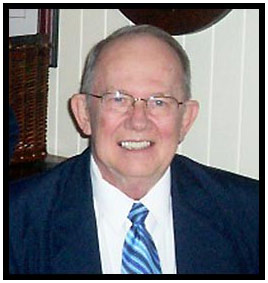 It is with great sadness that I report that my friend, colleague and co-author, John Waybright, has died. His family notified me that he passed away at 12:10 P.M., May 10, 2013. He gave his body to science.
John was a retired weekly newspaper editor. He earned Virginia Press Association awards for columns, editorials and newspaper page designs. He lived in Luray, VA, not far from George Quaintance's birthplace in rural Alma, Va.
In 2002, when I purchased a collection of Quaintance material at an estate sale, I searched the Internet for more information about Quaintance and that search led me to John. An email correspondence ensued, and after determining that there was little authoritative information about Quaintance in print, we decided to collaborate on a definitive biography. We agreed that John would write about the artist’s years on the East Coast and Ken (Furtado) would depict the years Quaintance spent in Los Angeles and Phoenix. Not only was John born near Quaintance's birthplace, he was a personal friend of one of Quaintance's only living relatives, who opened the family archives to him.
- Details
- Written by: Ken Furtado
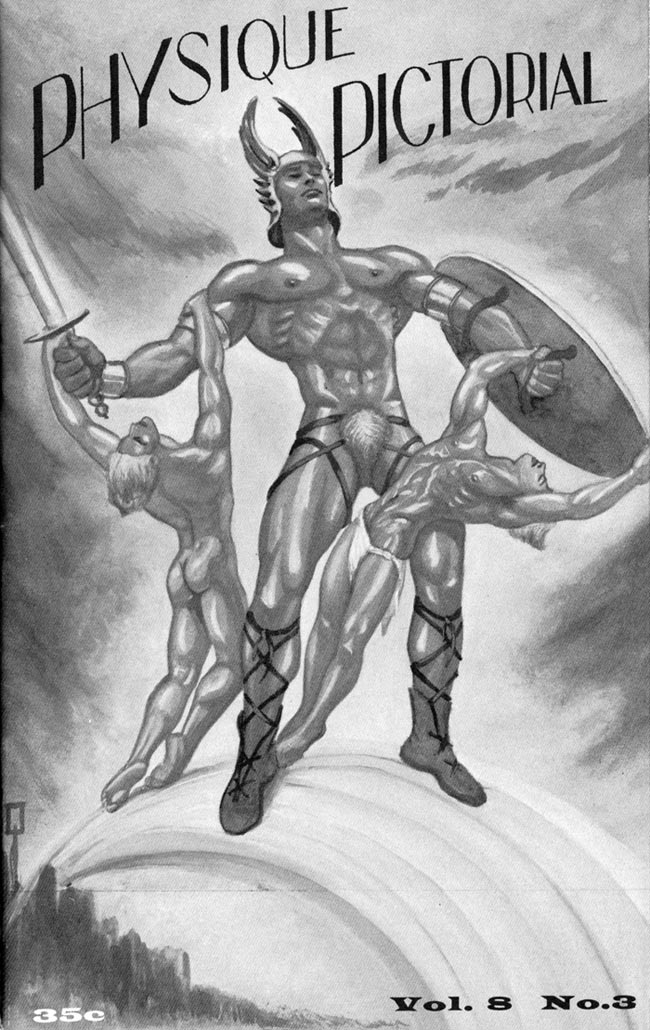 With his health declining, George Quaintance decided to sell the Phoenix property he called Rancho Siesta and move the studio back to LA. One is tempted to wonder whether the more ready availability of doctors and hospitals was a factor.
The painting Rodeo Victor was the last of his popular cowboy-themed canvases. Then came a pair of canvases with ancient themes, Spartan Soldiers Bathing and Baths of Ancient Rome, whereupon George's interests turned to the gods. In quick succession he painted Vulcan (aka Zeus), Bacchant, Falconer and Hercules.
Norse mythology was next. Quaintance announced in a letter to the publishers of Adonis and Body Beautiful, two pocket-sized color physique magazines for which he contributed several covers, that he had hired one of the most popular models of the day, Dick Dubois (1954 Mr. America and 1957 Mr. USA), to pose for his next painting. Dubois was the golden boy of the day, with his face and physique on countless billboards, advertisements and magazines across the continent. He even toured with Mae West as part of her stage show.
- Details
- Written by: Ken Furtado
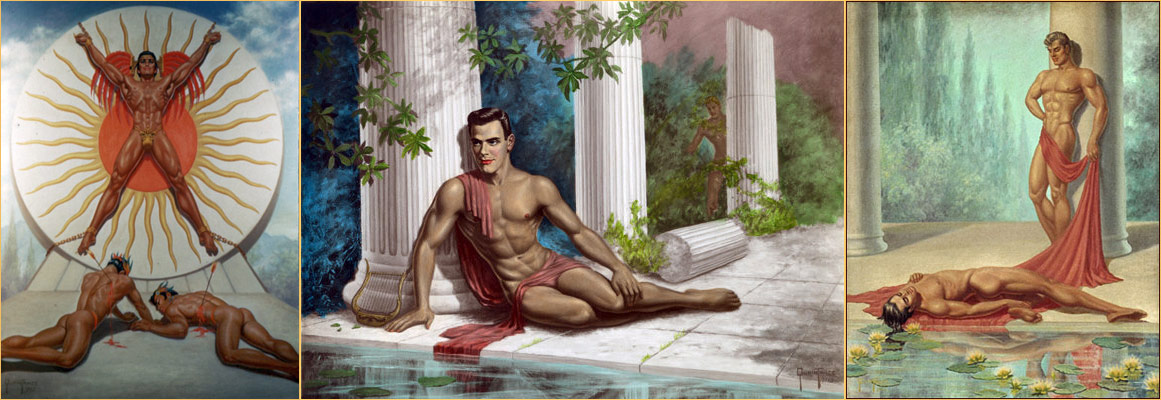 Quaintance was a man who liked to be in a relationship, and he had several illustrious partners, even if their renown was not widespread or did not outlast them. One such lover was Ron Nyman (1924-2000), younger by two decades.
Nyman was also an early business partner. They had stationery and business cards printed with both their names. Then Quaintance decided, as he later wrote to a friend, that Nyman was "a gold digger" ... and he kicked him out. Rather than waste good stationery, Quaintance carefully lined out Nyman's name on the remaining letterhead and business cards, and continued to use them.
Prior to the split, Nyman also modeled for three canvases produced by Quaintance in 1952. He is the manacled muscleman in Sacrifice, the foreground figure in Reverie and the reclining nude in Idyll.